
Key Takeaways
-
Discover how to master SLAs so you can win even more contracts, maximise service efficiency, and build lasting client relationships.
-
Learn why SLA monitoring is important for building your company’s credibility, and what challenges you might encounter along the way.
-
Uncover how service level agreement monitoring software can help you deliver on service promises, and the essential features to look out for.
Working with multiple commercial clients at once can put stress on your business and make managing SLAs difficult.
If you’re equipped with the right technology, you can avoid costly fines, ensure you don’t breach SLAs, and maintain great customer relationships.
Altogether, it means your team can work more efficiently and maintain strong client relationships, well into the future.
Keep reading to learn everything there is to know about the challenges of managing SLAs and the tools you need to manage them efficiently.

What is Service Level Agreement Monitoring?
Service level agreement monitoring, or SLA monitoring, is a valuable feature of field service management software. It helps businesses maintain and fulfil their contracted obligations to their customers, and is especially useful if you’re focused on property maintenance.
Each contract comes with varying levels of service that your company is willing to provide, and may include tasks like:
- Responding to a customer request within a specific time frame.
- For emergencies, confirming an engineer arrives on site within a certain number of hours to diagnose and solve the problem.
- Discussing and laying out the consequences your company will incur if unable to meet the agreed-upon terms.

It’s important to note that if you fail to meet the outlined service in an agreement, there may be a penalty. This can range from a fine, or a percentage off the price of the next service, to even resulting in your contract being terminated.
Check out HubSpot’s blog to learn more about how to create a service level agreement and establish the right terms for your business.
Why is Service Level Agreement Monitoring Important?
Service level agreement monitoring is important for three crucial reasons, designed to help field service companies establish credibility and commitment to a high-quality service experience:
- Setting a standard: Having an SLA as an additional part of a contract means both parties agree there is a standard of what “quality service” means to them.
- Establishing clear goals: The better your field service engineering team is, the more you can promise clients when it comes to meeting their needs and expectations. You can use SLAs to help set goals for your staff and provide incentives for them to improve your contracting services.
- Limiting Disruption: You may have an SLA that states the downtime of an asset won’t exceed “X number of hours.” Any time lost will negatively impact your customers and your business if you aren’t properly monitoring assets and their corresponding SLAs.
Five Challenges of Service Level Agreement Monitoring
As you know, trying to maximise the number of contracts your field service engineers can handle is no walk in the park. You might encounter a handful of challenges, like those below, which can fortunately be solved using software:
- Tracking and recording SLAs: The higher the volume of contracts your company manages, the harder it will become to track and record all their moving parts.
- Handling large datasets: If you’re unable to make strategic decisions backed by data and statistics, you’ll have a near-impossible time figuring out the best ways to streamline your business for maximum efficiency.
- Streamlining breach protocols: Even if you’re not often in danger of breaching SLAs, having the most efficient protocols in place for any emergency will help you maintain that perfect SLA compliance rate.
- Maintaining assets & managing downtime: It becomes extremely challenging to maintain client assets and manage downtime if you don’t have an automated system to keep track of all details listed throughout your contracts.
- Scheduling planned preventive maintenance (PPM): When trying to optimise your calendar and planned preventive maintenance schedule – you’ll be in the dark without tools like fleet management software or a dedicated customer portal.
Five Essential Features of SLA Monitoring Software
Now that you’ve seen some of the challenges that managing SLAs comes with, let’s look at the most useful features of using software to tackle them
1. Visual Countdowns and Timers
SLA targets are usually based on very specific time frames. Therefore, time tracking is a critical feature of SLA monitoring tools.
“How long do we have to provide the service?”, and, “what time will we breach the SLA?” are common concerns for trades businesses.
With multiple people working on jobs, tight deadlines, and stress, it’s easy for accurate timekeeping to fall by the wayside. Without a computer system monitoring SLA countdowns for you, there’s no dedicated point of truth.
You’ll need a timer you can rely on to track how long until an SLA breaches; it’s not good enough to risk depending on your employees to remember, especially when financial penalties and your company’s reputation are on the line.
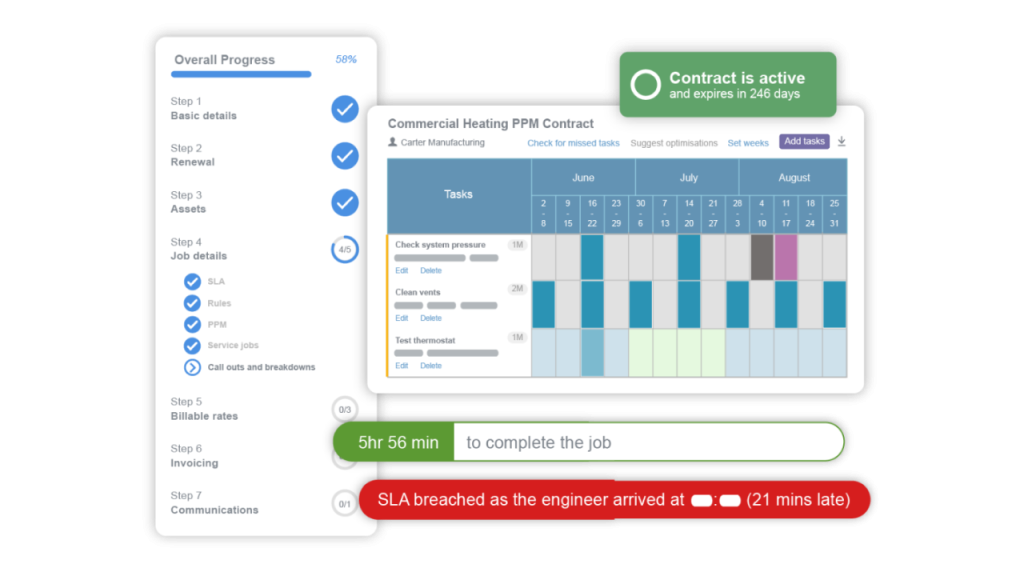
Service level agreement monitoring software can provide you with the high level of accuracy you ensure you’re satisfying service requests. With on-screen timers, any member of the office team can quickly check how long there is left to fulfil an SLA.
If the software colour-codes the timer (as it does in Commusoft’s service contract management software), you’ll have an easy way of visualising how things stand.
2. Breach Notifications and Warnings
Countdowns and timers make it easier to stay on top of SLAs, but nothing will always be 100% perfect and breaches are inevitable over time. This can be due to factors like traffic, a sick engineer, or other unforeseeable circumstances.
Before that happens, it’s ideal to receive a warning notification to let staff know that an SLA will soon expire.
Consider this example: your business offers an SLA for an engineer to be on-site within four hours. Imagine that three hours have passed and this hasn’t been fulfilled. Your software should be able to automatically notify and warn you that there is one hour until it breaches.
If the SLA does breach (e.g. the engineer arrived later than four hours), your operations director will want to be notified. Service level agreement monitoring software can provide instant notifications when an SLA is breached, ensuring everyone is kept in the loop regarding business performance.
Similarly, you may wish to send an automated email out when the SLA breaches. These can also be sent to customers, and are a good opportunity to be transparent. Use this email to acknowledge the breach and address any next steps, or follow up with any contracted requirements.
If your trades business wants to upgrade its service level agreement monitoring and reporting, automatic notifications and warnings are must-haves.

3. SLA Reporting and Analytics
Instant notifications let the operations managers know when SLAs breach. But what if they want to know how many SLAs were met (or not met) in the past six months?
That’s where reporting and analytics come in.
As you know, accurate reporting provides valuable insights into your business. For example, dedicated reporting can reveal if your team struggles with navigation, or if there are scheduling conflicts that are affecting your team’s ability to arrive at jobs on time.
If you work for commercial clients (or would like to), they may ask for your SLA performance or compliance rate. If you’re recording SLAs with a spreadsheet, attainment may be difficult to accurately track.
With records on every SLA, your team will always be aware of what’s going on. Reports allow staff to look back on breached SLAs and assess what could have been done differently to achieve a better outcome.
Knowing your numbers will place you in a healthy position for future contract negotiations. Whether working with repeat or new business, you can prove what your team is capable of achieving.

4. Segmentation and Customisation
When selecting software to monitor service level agreements, choose a solution that’s customisable to your needs.
Ask these questions when looking for a tool:
- Is there a logical way to assign which jobs have which SLA?
- If you have a standard contract with standard SLAs, is there an easy way to create a reusable template for that?
- Can you customise when a notification warning of a breach is sent?
Segmentation is a great example of a mechanism that improves user experience, helping you tailor service-level agreement monitoring to your business.
Not every job you do for a client will receive the same SLA. Some jobs may have none at all. With segmentation, the system can automatically control which jobs are assigned to which SLAs.
By doing this, you can ensure that when a matching job is created, the SLA will be applied without the team having to manually add it themselves.
5. Tracking Multiple Metrics
It may seem obvious, but you need to be able to track the different types of SLAs that your business offers.
SLA monitoring software will likely have different metrics hardcoded into them. And some won’t allow you to create your own. The question is, do they have the ones you need?
It needs to be able to measure the start action, the completion action, and the time between. If you offer complicated and specific SLAs, there may not be software that can properly measure them for you.
There are, however, several standard ones to look out for, including time to schedule a job, time for engineers on site, and time for completion.
If the solution you are currently using only offers some of these metrics, it may be worth looking for a more comprehensive software, like Commusoft, for your service level agreement monitoring.
Automate SLA Monitoring with Commusoft
From increased team efficiency to improved client satisfaction, there’s an endless number of ways job management software can take your business to the next level.
Expanding your client base and maximising recurring revenue is one of the best ways to grow your business and take advantage of every opportunity that comes your way.
Schedule a call with our team to learn more about how Commusoft can help.







 English (United States)
 English (UK)