
The Ultimate Sales Tactics Guide for the Trades offers trades businesses a comprehensive methodology of sales best practices to follow.
You and your team can use this guide to develop the mindset, structure, and skills needed to implement a winning sales strategy – and ultimately grow your revenue.
In this series of blogs, you’ll learn all about:
- Getting Started with Sales (this blog)
- Managing a Sales Pipeline
- Creating Proposal Templates
- Monitoring Success with KPIs & Reporting
By working your way through each article, you’ll walk away with the knowledge required to further develop your own expert sales strategies.
We’ve also provided a variety of downloadable resources for you to put into action, as well as videos, expert tips, and more for you to learn from as you create your sales plan!
To help out with sales terminology and ensure everybody is on the same page, this sales strategy guide includes handy definitions of key sales terms and phrases as they are used throughout.
We’re covering everything – from basic terminology to advanced software that will help your team manage opportunities.
There’s a lot to learn, so let’s jump in:

What is a Sales Strategy?
A sales strategy defines the long-term approach that your business will take in order to try and win work.
Your sales strategy plan should clarify the techniques, ideas, actions, and goals that your staff will aim for as they interact with prospects and aim to convert them into customers.
What are Sales Tactics?
Sales tactics are the specific actions your team take to convert prospects into customers.
Examples include building lists of leads and enrolling them into automated email sequences or offering discounts.
Your tactics should function to push your prospect over the finish line.
With that all said, there’s a very important question to ask: why do you want to improve your sales strategy?
Why Trades Businesses Need a Sales Strategy
It may seem like there’s an obvious answer: more money.
But the reality is all trades businesses will have slightly different motivations for wanting to improve their sales strategy (or for deciding to adopt one for the first time).
But what you wish to achieve isn’t necessarily the same as every other service, maintenance, or installation business out there; every business is unique.
As such, how you choose to implement your sales strategy will depend on your ultimate motivations.
Although every business is unique, it’s still possible to form generalized categories by motivation.
You may find your business fits neatly into one of the below categories, into two, or even all three – or perhaps none at all.
- Expansion: Businesses that are motivated by expansion are looking to win a greater number of jobs, hire more technicians as a result, and ultimately grow the size of their business.
- Process: Businesses that are motivated by process are looking to streamline how they sell, save time for their team, and improve their customer journeys. They don’t necessarily wish to complete more jobs.
- Profits: Businesses that are motivated by profits are looking to increase how much money they make per job and to optimize their margins. They don’t necessarily wish to complete more jobs.
Of course, these are not mutually exclusive groups; business expansion is difficult to achieve without a streamlined sales process – and improving your process can also increase profits.
But nonetheless, it can help you to start thinking about which of these motivations (or any other motivation) is most important to you and your business.
The Difference Between Sales and Marketing
If you’ve arrived at this guide hoping to learn how you can get more leads or increase your presence on social media, you may be mistaking sales for marketing.
If you’ve arrived at this guide hoping to learn how you can get more leads or increase your presence on social media, you may be mistaking sales for marketing.
While they can be similar (and are intrinsically linked) it’s vital to understand that sales and marketing are sequential: all the marketing efforts your business makes are what feed into your sales.
Trades Marketing
Marketing is all about acquiring leads, whether through your website, over the phone, or by word of mouth.
Trades Sales
The Sales process begins when you or your sales team reach out to new leads and begin the active process of selling.
Effective Sales Tactics for the Trades
The more leads, the merrier, right?
This is true to a certain extent. Increasing the number of deals won is a great victory, but the quality of these jobs is most important.
For example, three small parts swap jobs can be equivalent to one full-scale appliance installation appointment. Larger-value deals ensure you can meet, and exceed, your selling quota with fewer deals won.
At the end of the day, the sales teams with the most effective selling approach win deals. When you harness the best strategies, many of which are covered in this guide, you’ll be sure to win the high-quality services you want most!
Now that we’ve touched on motivation and the difference between sales and marketing, let’s begin the Ultimate Sales Tactics Guide for the Trades with a deeper look at the sales mindset and why it’s so important.
Which is your most important motivation when it comes to sales?
Expansion
So, it’s all about growth: more customers, more jobs, more technicians?
To achieve those goals and give yourself room to focus on your business’s expansion, you’ll need to master your selling across all the points in our sales guide.
For further tips on hiring technicians check out our blog that details the top field technician interview questions.
Process
Saving time, reducing admin, and becoming more efficient is what you’re after?
You’ll want to explore our section on managing your sales pipeline. We provide a detailed approach to help you make your sales more systematic with a sales pipeline.
Profits
Looking to maximize how much money your team brings in?
If you aren’t explicitly looking to increase the quantity of jobs too, check out our blog on proposals: it’s all about helping you develop multiple options and add-ons for customers to choose from in a job proposals.
Rethink Selling with a Fresh Mindset
Developing a sales strategy framework is one of the most important things that your trades business can do to improve sales.
However, creating a winning sales strategy may first require a company-wide shift in how you think about selling.
That’s where adopting a sales mindset that focuses on your customers comes in.
What is a Sales Mindset?
A sales mindset is all about the mental attitude and approach your team takes to selling.
With the customer’s needs at the forefront of your mind, a sales mindset encourages staff to think more strategically about how they engage with a prospect and how they can find the right solution for them.
A sales mindset should not focus on the hard sell, being loud, or pushy: it’s about positive connections. Recruiting the right people to sell for your company is important.
There’s a lot more to winning business than simply having the ability to complete the job. Your competitors will likely have the same technical skills as your team, so it’s important to ask what it is that should make people choose your business, instead of theirs.
Most trades businesses don’t necessarily think of what they do as selling; most will consider what they’re doing from a technical perspective, thinking of each job only as a task that needs doing…
— Jason Morjaria, CEO of Commusoft
But by adopting a sales mindset, you can shift your thinking to both recognize and prioritize the many aspects that affect a customer’s decision to do business with you.
Any new sales strategy you implement will be underpinned and driven by this foundational mindset.
This will improve how you interact with customers and help you win more work.
How to Develop a Sales Mindset in the Trades
Defining unique selling strategies for your sales team isn’t easy.
Stop Quoting, Start Selling
The first step to adopting a sales mindset is to understand and acknowledge that what your business does is selling.
Whether you’re in plumbing and heating, HVAC, electrical, facility maintenance, or any other trades industry, the one thing all of these businesses have in common is that they sell. This could include products, services, and most importantly, themselves.
One of the biggest traps that trades businesses fall into is believing that the simple act of sending a quote is all that the sales process entails.
That’s a negative sales mindset and couldn’t be further from the truth. If this is how you view sales, your business needs a new, positive sales mindset, one that helps you to stop quoting, and start selling.
But… aren’t they the same thing?
What is Quoting?
- Quoting (or estimating) is the basic process of sending a price, a list of parts, and perhaps a brief summary of the work to be completed to the potential customer.
What is Selling?
- Selling is a much more comprehensive process. Selling encapsulates everything from attracting leads, consulting, sending a proposal, effectively following up, and ultimately closing the deal.
By being more proactive and less passive, your business can develop a winning sales process that reliably grows your revenue.
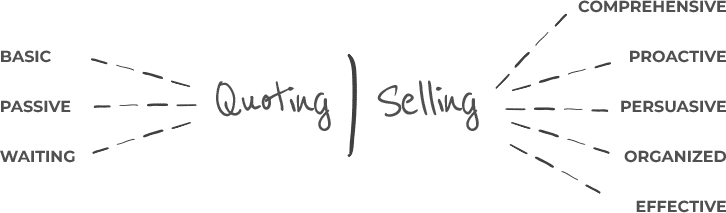
Adopting a Sales Mindset:
Your next (and perhaps greater) challenge will be to get the rest of your team adopting a sales mindset, too.
Here are seven tips to help you get started!
1. Set Clear Sales Goals
Working towards transparent targets makes it much easier to surpass your quotas.
Besides the obvious increase in deal size and deal won rate, you can set a number of cold leads to reach out to each month, a target for email opens, or work to reduce the overall length of your sales cycle.
Remember, your goals should motivate your salespeople, not discourage them!
2. Build Confidence
For your sales team, their confidence will grow when they meet and exceed their personal and team goals.
For your prospective customers, establishing and increasing trust in your team and services is essential during your selling process.
Converting more leads into customers will be easier once you prove you’re the best team for the job.
3. Emphasize Customer-Centricity
Your customers come first! You know this. Bigger deal sizes are a great win, but meeting customer needs is essential. It’s about providing the best solutions – not just boosting your revenue.
That’s why listening to each prospect is so important.
4. Practice Active Listening
Understanding and solving your prospects’ unique needs will set you apart from competitors.
Active listening will make it easier for your sales team to both qualify and disqualify leads. You might be tempted to sell the most expensive appliances and parts, but they might not be the best option for your customer and their needs.
Selling is a two-way street: both your business and prospective customer need to be good fits for each other.
5. Use Persuasive Language
An extension of active listening is understanding how to compel leads to choose you.
There’s a razor’s edge between being helpful and too pushy or “salesy”.
Tracking why your customers chose you makes it easier to discern what your prospects will likely care most about too.
6. Leverage Technology
There are so many great digital tools your team can use to effectively manage and oversee all sales activities.
Digital sales pipeline, lead tracking, and proposal builders ensure sales teams stay on top of each opportunity. The best sales software are all-in-one solutions that integrate with your job management platform.
This makes the transition of notes and files from your sales to the service team seamless!
7. Seek Continuous Improvement
Complacency is the death of the best teams. Like any great business, you should always work to better yourselves and your offerings.
If you’re interested in either narrowing down or diversifying your services, look into past sales.
What services are and aren’t bringing in the most profits?
This can help you determine where you’re excelling and where you need to make improvements.
Get your Team to Adopt a Sales Mindset
Selling requires a united front. Each team member can impact your sales in one way or another, which is why you must be all on the same page.
Whether it’s the person who answers inquiries, the in-field surveyor (or as we’d call them, a salesperson), or the technician who completes the job, everybody contributes to the lead’s or customer’s perception of your business and their likelihood to choose yours.
A sales opportunity management platform can help your entire sales team accurately track specific details for individual deals. This means information is always available and can easily be shared.
Further, it enables team members to action tasks quicker.
If everyone is aligned with the same sales mindset, it allows your team to be more consistent, more efficient, and ultimately helps you to secure more revenue.
What Should Your Team Be Aligned On?
- Why the sales strategy impacts your company goals (and what those goals are)
- What the sales process looks like from start to finish (plus what all those sales terms mean)
- Who is responsible for which steps of the sales process
- When each sales action needs to occur
- How to communicate the value of your services at each touchpoint
How Do Different Team Members Influence Sales?
Let’s take a quick look at how different members of your team impact sales; you might have lots of employees, or only a handful, but everyone has a role to play.
- Owner/Manager: Impacts the overall strategy, direction, and alignment of sales across the business. If they are also chief salesperson, their attitude and approach greatly influences customer relationships too.
- Office Staff: Typically the first touchpoint for leads. Their initial interaction sets the tone for what comes next. Are they prompt, polite, and informative? Do they understand what their goal is when handling a lead?
- Technicians: The first person from your business that the lead will likely meet face-to-face. Are they arriving on-time, professionally dressed, and thoroughly listening to the lead’s needs?
What happens when one person handles your sales?
The reality is many smaller trades businesses won’t have multiple people dedicated to selling. If you are solely responsible for sales in your company, it’s still vital that you align your sales mindset with your objectives.
Do you know what you want to achieve when it comes to selling and do you have a plan to achieve it?
What Happens After Adopting a Sales Mindset?
With this sales mindset adopted, your business will have a renewed focus on how you plan to grow and increase revenue through selling.
A sales strategy framework that aligns your team will ensure employees can understand how they contribute, can work more productively, and may stay more motivated too.
Of course, you still need to define how you’ll implement your sales strategy and how you plan to manage the process of selling in your company.
Jump into our next blog, where we’ll show you how to master your sales pipeline.
Sales Glossary
Here’s a list of terms you’ll find used throughout this guide:







 English (United States)
  English (UK)