
When it comes to managing large-scale maintenance contracts for your field service business, the key challenge lies in managing their variety and complexity.
In this blog we cover all you need to know about making your commercial contract management more efficient.
Compared to residential contract management, where it’s all about learning to manage the volume of work, commercial maintenance contracts carry more weight. This means that your business has greater responsibility, risk, and increased liability to handle.
With so much more at risk if your service business fails to deliver on the terms of your contracts, you need to be prepared.
Failure means suffering more than a bit of damage to your reputation, or losing a single customer: failing a large-scale contract can cripple your business. It’s therefore necessary to understand how you can better organise large-scale contracts and their risks so you can protect your business.
Let’s explore how the right software can help you manage your maintenance contracts with confidence.

Why Is Contract Management Software Important?
It’s very likely that you’re already managing a wide variety of contract-types. You’re probably also involved in carrying out planned preventative maintenance (PPM), or committing to service level agreements (SLAs).
However, if you’re reading this guide, it’s increasingly likely that your current tools simply aren’t supporting you…
As the responsibilities you take on increase, you’ll have noticed that there’s significantly more moving parts and complexities for your team to manage. If that’s the case, then you know your business could be at risk and you’re seeking ways to improve your commercial contract management.
It’s important, then, to explore more proficient solutions and tools that can help ease the pressure and cope with the challenges facing your company.
But the challenge of managing these large-scale commercial maintenance contracts isn’t just in overseeing their many and varied moving parts. It’s also about keeping your team in control and managing them with confidence.
With greater oversight of contracts, you’ll ensure that your business is:
- Managing every contract more efficiently, without crossing wires between different systems.
- Operating at scale, whether it’s thousands of tenant properties or a single client.
- Preventing problems with day-to-day jobs and handling routine maintenance, PPM, and emergency repairs smarter.
- Giving customers confidence in your services by meeting the expectations of your service contract.
This ultimately means you’ll be able to more effectively fulfil your contractual obligations and keep customers happy.
Understanding Risk and Managing Liability
Perhaps the biggest point of concern for managing large-scale maintenance contracts is risk.
It’s important to understand what it means to take on this type of contract and have a solid understanding of the risks.
What is risk management?
A business should only take on a contract (of any size) when they fully understand the risks involved.
After all, by taking on a contract, your business is accepting liability and is obligated to fulfil the services described in the contract.
The bigger the contract, the greater the risk.
Risk management, then, refers to how a business evaluates and understands the requirements and consequences involved if contractual obligations aren’t met.
By evaluating the risks (which can include financial, safety, legal, and more), a business can establish procedures that help them avoid, limit, or reduce the impact of these risks and their consequences.
For example, if a business is taking on the HVAC maintenance of an office building, just a few of the risks they need to account for are:
- Safety hazards
- Financial and operational costs
- Maintenance tasks
- Impact to occupants
- Building regulations
- Cost of not meeting SLAs and consequences of contractual failure
Details of these risks must be incorporated into the contract. But it’s awareness of these responsibilities and the consequences involved — ranging from fines to complete loss of a contract — that indicate if a business should take on the contract.
Different Types of Contracts and Risks
The main types of contracts looked after by services businesses are the following:
- B2C – Residential/service contract agreements
- B2B – Commercial contracts
- B2B2C – Commercial estates/property management
While they have some details in common, it’s B2B and B2B2C maintenance contracts that are most lucrative. They’re also the most difficult to manage due to the complexities and risks involved with them.
Though we’ve briefly touched on all three types of contract, the rest of this blog focuses on B2B and B2B2C contracts. But if you’d like to learn more about B2C contract management, explore our Complete Guide to Home Service Plans.
B2C Contracts:
A good example of a business to consumer (B2C) contract is a care plan covering a homeowner’s heating system, like their boiler and radiators. A plumbing business may take on a contract, agreeing to maintain and repair these assets.
They’re lower revenue contacts, with low risk.
As such, if your trades business fails to repair and maintain the boiler, there’s very little risk to your business on the whole. Customers may be disappointed, but your business is unlikely to run into significant pressures, and solutions (like replacing a boiler) will be much easier to implement.
B2B Contracts:
A business to business (B2B) contract carries more responsibility and risk, but an increased financial reward.
Consider the following: you have a contract to maintain the HVAC system of a factory. Should their air-conditioning system fail, the building will become too hot for their employees to work in, and your client will have to cease production of goods and send their staff home.
The risk to your trades business if it fails to fix or maintain these assets may cost your client an entire day’s production (or worse) and cost them tens of thousands.
Within the B2B contract, it may stipulate that there are fines for failing to meet certain requirements. This can also apply to missing an SLA (more on that later). It may mean that the factory sues your business for breach of contract.
In this worst-case scenario, not only are you likely to lose a lucrative contract, but it would lead to a significant loss of revenue.
B2B2C Contracts:
Business to business to consumer (B2B2C) contracts can overlap with residential B2C contracts, such as working with estate agents/property management and their tenants.
The risk here is high, but so are the revenue prospects. There’s more complexity, especially if you cover thousands of properties and tenants across multiple areas.
These contracts can contain additional legal protections and even greater risks to manage, and breaching the contract terms can be very damaging for your business.
What’s Included in a Commercial Maintenance Contract?
Let’s break down what’s included in a commercial maintenance contract and what they mean.
1. Job Description and Scope of Work
The job description details the types of service covered in the contract. You may also include exclusions in the contract, to ensure it’s clear what your business is and isn’t responsible for, as certain maintenance could fall to another party.
The job description itself has information about preventive maintenance, emergency repairs, reactive maintenance, call-out frequency, and asset monitoring.
2. Property Type and Information
This defines the property/properties being serviced, as well as specific locations. Addresses are listed to ensure that all parties are aware of exactly where the jobs will take place and where you’re responsible for monitoring. This section may highlight permits, how to access the property, and safety protocols to follow as well.
Keep in mind that it’s useful to specify the number of properties under contract, the size of the customer base.
3. Points of Contact
Contracts should list the key points of communication. This can include who the lead contact is, how best to communicate, what steps to follow, etc.
4. Assets
Similar to the property, a complete list of the assets you’re contractually obligated to care for are listed. This makes clear what your business is responsible for under the terms of the contract, and can be tracked with asset maintenance software.
It may include details about warranties of said assets or guarantees on the workmanship carried out, too.
5. Labour and Materials
The terms and conditions of the cost of materials and staff labour are stipulated too.
This is useful when detailing whether the cost of materials is covered, or if it’s expensed at an additional cost. This must be clear so there’s no confusion for any parties.
6. Billable rates and rules
Define the costs associated with the contract, which usually covers maintenance fees and the overall cost of the contract. Rules may also highlight additional costs i.e. how much you should charge for additional service work.
A particular challenge of commercial contracts is managing different billable rates and terms across a variety of contracts: there’s no one-size-fits-all fee.
7. Contract Length/Type
This specifies how long the contract runs for as well as any break clauses, giving both your business and/or the customer room to terminate the contract under certain circumstances.
It may also contain information about renewing the contract and the steps required.
8. Invoicing Schedule
Alongside the payment details, the contract explains how often a client is billed for your services.
Smaller businesses or residential customers may prefer monthly invoices, but larger businesses could pay a yearly fee and cover all costs at once. With the right invoicing software, you can compile monthly individual invoices into one lump sum easily.
9. Payment Methods
This covers payment methods for any service completed. Are you charging upfront, quarterly, or yearly? This should be stipulated in the contract so it’s clear to your payments team and the customer.
You might then stipulate how a payment is delivered/received; you could set up recurring payments via direct debit, for example.
10. Contract Renewal
As well as invoicing and payments, the contract should include the terms of renewal, such as annually, every two years, or more. Depending on the type of service you provide, it may be wise to take a flexible approach.
Signing long-term contracts is only advantageous if you have a strong partnership and confidence in maintaining it long-term (something made easier by a well thought-out risk assessment).
11. Service Level Agreements
The SLAs in the contract are targets you’re required to achieve. This can range from time sensitive responses and emergencies to repair completion times, guarantees, and communications between the service provider and customer.
12. Planned Preventative Maintenance (PPM) and Task Building
This explains the steps followed at the job. For example, if you’re a plumbing contractor, it would mention checking details such as water pressure, pipe health, flushing of drains, and safety valves. You’d then expect to see a complete breakdown of all the agreed upon checks required.
Other information that must be included is PPM scheduling, which refers to the frequency of site visits and can include details relating to additional call-out requests and checks. As mentioned in Billing Rates/Rules, these checks may come at an added cost.
Managing schedules can be a big challenge, particularly when maintenance can take days to carry out. There could also be time-sensitive requirements to ensure assets are maintained and legally compliant.
13. Reporting
For large-scale contracts, you’ll need to feedback and communicate on the maintenance you carry out and share other service information. This portion of the contract will make that clear.
Beware That Terms Can Vary
While these points appear in most contracts, the exact details will always differ depending on the contract type.
This is part of what makes commercial maintenance contracts much more complicated to manage without the right tools.
The number of assets drastically increases, SLAs become varied and bespoke from client to client (as do the consequences for missing them), and so risk overall becomes greater.
For commercial maintenance contracts, there’s no one-size-fits-all style that’s easy to understand. Instead, you need a single, powerful tool that makes managing them simple and straightforward.
Using Dynamic Software to Improve Contract Management
Using contract management software relies on being organised from an administrative perspective. After all, this is where the majority of the contract management burden lies.
But, when managed well, you can mitigate the risk of something going wrong with a job, payments, or communications.
Arranging and delivering your services also becomes comparatively easier, relieving employee stress and ensuring they aren’t getting lost in the details of each and every contract.
Instead, they can organise everything with confidence and can execute the service contract without issue.
Let’s take a look at how contract management software can help your team manage maintenance contracts more effectively.
The Role of Automation
Working smarter, not harder is the goal when managing commercial maintenance contracts. And these days, there’s lots that software can do in order to maximise efficiency within your service business.
Keep in mind that a lot of these resources apply to your business at scale, not just for contract management!
An all-in-one management system can be a huge game changer for your service business. It’s full automation you’ll need, which allows you to control everything from job management, invoicing, to reporting, and more.
One of the best ways to manage large scale contracts is to rely on automation software that saves time everywhere: not just on niche tasks.
With automated tools helping you take care of the admin tasks, you can rely on your management system to pull data instantly so it’s ready for your team. This way, no matter their situation, they have all the information they need.
Below we take a look a few specific automation tools in more details, as these will be especially helpful when it comes to contract management:
Payment Integrations
With payment integrations, you can easily: charge landlords for monthly recurring payments, establish rules for additional charges, create payment terms, and add costs for repairs and emergency work, or even discounts.
When payment data is included in your system, you can rely on the relevant data being pulled into contracts automatically. This saves time finding and entering data, streamlining data entry for your admin staff.
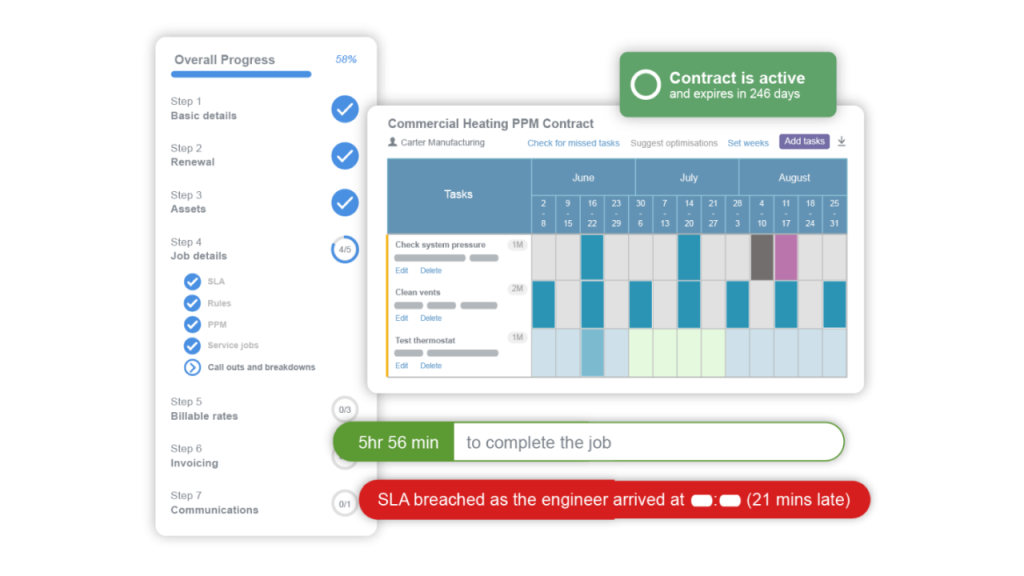
PPM Scheduling
This allows maintenance plans to be scheduled in detail and jobs automatically raised weekly, monthly, or quarterly, so there’s no doubt what needs to happen and when.
PPM includes tasks for each and every job description in the contract.. This way, you can automatically create jobs and assignments for your engineers and always take the correct action as defined in your contract.
With an SFG20 integration, for example, you can incorporate existing maintenance schedules into your PPM schedule to save time for common assets. Trades businesses who use SFG20 to create and manage building maintenance schedules can upload PPM lists directly into their account. Integrating your SFG20 Data can reduce errors and ensure industry compliance.
SLA Monitoring
Seamlessly track a variety of metrics and priorities, ranking them from urgent, important, medium, to less important tasks). And with automation, you can easily track SLAs and promptly respond to breaches.
Swift reactions will improve your SLA attainment rate and boost company revenue.
By using software, staff see when an SLA starts as soon as a job is created. They’ll also be alerted automatically if an SLA will soon breach and enjoy greater transparency and accountability.
360-Degree Timeline View
A single customer view approach presents staff with all job history, details, assets, of every customer. This way, teams can use software to respond rapidly and in real-time.
Such a display improves all aspects of customer service and service delivery for things like payments, scheduling, and communication.
Understanding Planned Preventative Maintenance
PPM is a proactive approach to caring for your customer’s assets or property.
By scheduling PPM, you can increase the longevity of a customer’s asset, reduce the risk of a breakage, improve safety standards, and more.
In action: an engineer carries out quarterly and yearly checks of an office block’s fire safety equipment. This would involve checking all alarms are in working order and that fire extinguishers and suppression systems are functioning/in-date. Scheduled routine maintenance guarantees the building’s safety and covers your business’ liability.
Benefits of Managing PPM with Software
Planned maintenance is preferred by most customers, since this strategy saves them both time and money in the long run.
Customers benefit from extended asset life and workplace safety, while your business can secure regular job bookings with service reminders, provide unparalleled service, and make bigger profits.
Use PPM to build productive workflows so you can operate smoothly, every day. Impress your customers with a single customer view that helps you access information and respond immediately.
And boost revenue thanks to tools that allow you to get paid easily, order parts only when needed, and secure jobs seamlessly.
We’re happy because if we get in early, carry out the service early, we can pick up problems early, and that can save us a whole host of money. So it’s a really good benefit for us.
Gurminder Jassal, Director of G Jassal of All Trades
The Importance of Service Level Agreements
Service Level Agreements (SLAs) define the expectations of the service you provide to your customers.
They signify your promise to meet set standards. Failure to meet an SLA can have consequences, such as a fine or termination of the contract.
In action: for most field service companies, SLAs are time-sensitive and may look like the following:
- “An engineer will arrive within 30 minutes of an emergency appointment being requested.”
- “A maintenance job, once started, will be completed within 2 hours.”
Benefits of managing SLAs with Software
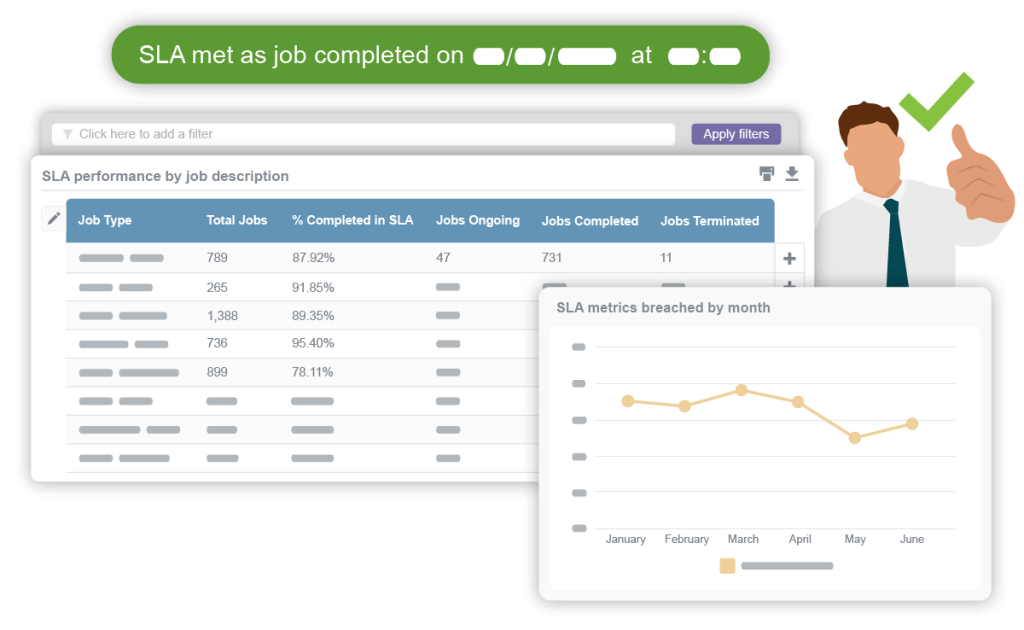
Your team can better manage your agreed SLAs with the right software like Commusoft, where they can be tracked automatically with handy features like colourised SLA countdown timers.
An organised system ensures everyone involved with the job is aware of contact terms and when they’re due to breach. It can also help your team determine where you excel, highlight areas for improvements, and what terms need updating in the future.
Service-level agreement software allows you to build a workflow for how to respond when contractual agreements are breached. This level of monitoring enables managers to contact customers straight away, explain why the agreement was breached, and offer discounts if necessary.
While a breached agreement brings consequences, monitoring software can vastly improve your team’s response times and overall customer service. With that, you can expect to avoid issues more easily and prove your commitment to your customers.
Phil Mulvenna, Managing Director of Premier Heating, explained how Commusoft supports with this process:
SLAs are really important for our business; they help us track the service we offer. If the SLA isn’t met, I will get a notification, or my manager will get a notification, and we can look at why that happened, and be on top of the situation before it escalates.
Benefits of Commercial Contract Management Software
Contract management doesn’t need to be complicated; that’s why it’s so important to use a well-structured, intuitive tool.
Ideally, the tool should:
- Have a good selection of contract templates
- Allow you to customise your contracts
- Help you find the details you need, when you need them
This allows your team to have full visibility of the relevant information and administer contracts at scale, significantly reducing their administrative burden.
With that in mind, let’s turn to the key benefits it can have for your field service business:
- Increased scalability and volume of work
- Streamlined communication and record-keeping
- Enhanced scheduling and dispatching
- Automated reminders and reports
- Improved data analysis and decision-making
- Revenue Security (for bigger contracts)
- Connected functionality (thanks to an all-in-one, out of the box solution)
We’ll now explore these in more detail, considering core challenges and then the benefits of using software to improve efficiency.
1. Increased Scalability and Volume of Work
Challenge: juggling multiple contracts and clients can create challenges. Each agreement will have varying terms and requirements, which can lead to confusion, missed deadlines, and potentially costly mistakes.
Benefit: a software system holds all your data in one place, wherever your team is working. Centralising information and automating tasks simplifies workflows and allows you to manage a higher volume of contracts.
2. Streamlined Communication and Record-Keeping
Challenge: you’re well beyond using paper to keep track of records and already used to sending digital reminders. But without automation, delays and mistakes still occur and can crop up all too easily.
Benefit: streamline communication with your clients and make it easy for them to view their data via a customer portal. Your team can also send communications promptly and accurately, as they’re able to input, access and update data in just a few clicks.
3. Enhanced Scheduling and Dispatching
Challenge: tracking schedules with an ineffective system can result in incorrect resource allocation and missed services. Delays could be costly and hurt your team’s productivity.
Benefit: by using software to create jobs for specific timeframes, you can optimise schedules for every engineer based on their availability, location, and even skillsets. With an automated system, you’re far more likely to get your staff to an appointment on time and meet your contractual requirements.
4. Automated Reminders and Reports
Challenge: reliance on manual reminders to keep your team aware of preventative maintenance or upcoming contract renewals can lead to missed deadlines and revenue loss.
Benefit: automated service reminders can prompt your team and customers at different intervals.
It’s then no longer just one person’s responsibility to remain up-to-date with PPM, as everyone is involved and coordinated regarding upcoming service needs and contract renewals. This is great for saving time, keeping customers happy, and securing recurring revenue.
5. Improved Data Analysis and Decision-Making
Challenge: without easily accessible data, it’s difficult to manage your responsibilities, especially if you’re juggling SLAs or reacting to emergency appointments. Additionally, it’s challenging to know whether you’re fulfilling (or failing) your contract terms.
Benefit: software provides insightful data for analysis and reporting. You can identify trends and better understand areas for improvement, too. It’s only through well-organised data that you can hope to optimise your service delivery, and make decisions that improve your services.
6. Revenue Security (for Bigger Contracts]
Challenge: complex contracts often have a wide variety of requirements, SLAs, contacts and billing structures. They can be a nightmare to manage and require excessive manpower, potentially making them more costly, time-consuming and prone to errors.
Benefit: create flexible billing that’s easy to calculate and automate through an all-in-one system. Take the guesswork out by billing on agreed-upon rates and enjoy fast calculations, all of which you can easily monitor and maintain to safeguard your revenue.
7. Connected Functionality (an All-in-One, Out-of-the-Box Solution)
Challenge: it’s harder to do a job well if you’re using a range of software solutions for different aspects of contract management i.e. job assignment, finance, parts, communication.
Benefit: an all-in-one solution simplifies operations and brings everything together under one roof. Your data is aligned and easily accessible, keeping customer and colleague interactions simple and straightforward.
Commusoft: the Ultimate Contract Management Software
With Commusoft, you decide which metrics are measured by each contract. Of course, this means you can rest easy knowing you can manage them all, no matter what they are.
For different contract terms, keep everyone happy with the ability to edit contract details on a customer-by-customer basis.
We’ve simplified contract management so that your needs are always met, meaning you can always meet the needs of your customers in turn. Use our dynamic software to:
- Manage complex planned preventative maintenance schedules
- Ensure you never miss an SLA thanks to warnings and notifications
- Create customised contract templates e.g. including SLAs or PPM
- Handle contract operations alongside job management tools
- Save time for common assets with our SFG20 integration
- Incorporate existing maintenance schedules into your PPM






 English (United States)
  English (UK)